
"... there is absolutely no inevitability as long as there is a willingness to contemplate what is happening."
"The Medium is the Massage"
Mashall McLuhan
& Quentin Fiore
Bantam, 1967 |
|
|
HPC forthcoming publication
|
|
| |
|
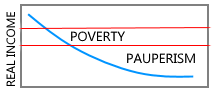
Real incomes are an expression of the degree of freedom people, families, companies & shareholders have to achieve their freely determined objectives.
Real incomes should therefore be of prime concern to economists & politicians.
However, the freedom of self-determination, no matter by whom exercised, needs to be subjected to constitutional norms to protect each individual from impositions by others. |
|
|
Extra-Constitutional IssuesThe twin peaks approach described by Hector Sants needs to be revamped to include legal constitutional and ethical issues. The current drift under the weight of the bank lobbies, trying to resist more regulation, is that we are likely to end up with another extra-constitutional set up similar to the one that created the current financial crisis. It is not surprising that Hector Sants has resigned from his post. However, it is politicians and political parties who have a direct interest in maintaining extra-constitutional arrangements where the public is neither protected nor compensated sufficiently from bad decision-making. The protection of the electorate from unethical and incompetent decision-making and the provision of the means to arrive at timely and just settlements for adequate compensation are fundamental constitutional imperatives. The elimination of extra-constitutional arrangements would be a sign the Government wishes to move the country towards a democracy that defends the freedom of its citizens through a Parliment that represents the will of the people.
read more ...
It all depends on what happens to ....Professor Lorie Tarshis, Head of the Department of Economics at Stanford University, would often respond to questions on the outcomes of policy actions beginning with the words,"It all depends on what happens to ....". What would follow was an elaborate description of all of the factors that in fact determine outcomes. This was complicated enough but this was deemed to be realistic around 1968 when things seemed to work. A few years later things were not working and the inability to predict outcomes under severe market shocks was exposed to be an unaccaptable characteristics of both Keynesianism and Monetarism. Unfortunately KM economists remain in denial and politial leaders haplessly believe that "there is no alternative". Such disinformation is extracting too heavy a price from the economic and social constituencies.
read more ...
| "Leading Issues in the British Economy"
The HPC review panel has proposed that by substituting the original text (600pp) by 2 books covering:
The Real Incomes approachapplied policy design - about 100-150pp
Constitutional Imperatives in Economicstheory - about 450-500pp
would greatly enhance the focus and practical utility of the publication exercise. Real Incomes policy delivers traction through operational modalities that do not exist in the KM economic theory, derived paradigms or policy. Therefore the production of this shorter text represents a significant intellectual challenge to communicate the theoretical differences and policy design implications. I will aim to produce the applied policy design publication by end of 2nd Quarter, 2012. Hector McNeill |
|
| |
Why no "alternative" policies are proposedAusterity, suffering, growth and inflation, the conventional economic models offer dire options where policy imposes deprivation and externalities in the form of winners, losers and policy neutral states. Fundamentally, the evolution in macroeconomic theory, even of opposing schools of economic thought, have become completely biased towards financial processes to the extent that physical process are ignored. This process started well before the Great Depression and continues to this day. "Solutions" proposed and enacted to solve the issue of excessive financialization are themselves policies founded on the same financialization model. The macroeconomic theory itself is flawed and this is why economists are not coming up with "alternative" policies.
read more ...
Front End Loading & the Bonus Culture
There is a fundamental confusion between sales commissions on dispatched physical goods where the correlation between commission and corporate performance is high and the case of investment, bank deposits, lending, insurance and derivatives trading where there is almost no immediate correlation between sales and performance. In the case of services, sales values have little relationship to future performance of the service sector. The habit of "front end loading" is deeply engrained in the financial intermediation sector. This habit also includes the "bonus culture" which can have performance impacts that range from the insignificant to pernicious effects culminating in the total destruction of a service and loss of client funds.
read more ...
Appropriate Pricing Models
Conventional notions of supply and demand do not provide a transparent basis for identifying macroeconomic growth strategies. This is because they misrepresent the real transactional dynamics that depend upon nominal income levels and production economics. What is important is growth in real incomes and profits not inflationary nominal aggregate incomes growth. Macroeconomic models used to identify appropriate real incomes growth paths need to be built on firm microeconomic foundations. Such models can provide a basis for simulating the impacts of pricing strategies on real economic growth.
read more ...
Constitutional Economics shifts to the forefront, reinforced by the Real Incomes Approach
The reasons for failure of KM policies is fully mirrored by the types of arguments that are used to criticise constitutional economics. Basically, there is a need for an economic model that enables assemblies that represent the people to gain a constitutional control over the extremes of influence of small interest groups; influences often exercised by non-constitutional means. Many of the shortcomings of constitutional economics are to be found in the mechanisms whereby politicians subvert constitutional provisions or change them to suit partizan interests.
No one voted for the current financial crisis and no one voted to transfer a significant proportion of national income to the financial intermediation sector (banks). No one voted for a situation where incomes and employment will fall while those whose caused these problems benefit from higher job and income security. Those paying for incompetence are not those who exercised poor judgement while many "innocents" will lose their employment; this reality highlights the inequitable outcomes of KM policies attempting to address macroeconomic problems. The failure to embed constitutional norms into macroeconomic policy demonstrates that democracy, the form of governance peddled by the West, elsewhere, has failed to safeguard the welfare of constituents and people in other world economies. The Real Incomes Approach offers ways and means to strengthen democracy in a meaningful fashion.
read more ...
A Real Incomes Approach to macro prudential management
The former discussions centered on the Bank of England and Financial Services Authority and Mervyn King's appeal for a macroprudential management should not be cast aside in the current flurry of discussions concerning the Eurozone's financial crisis. In all cases the proof of the pudding is that neither Keynesianism nor Monetarism ever held out solutions to major international commodity or financial market shocks. This was one of the findings in the first publication on the Real Incomes Approach in 1976. Indeed to insist on applying the theory and practice of KM policies only deepens the problems.
read more ...
Real income - some basic relationships
Although unit prices and quantities of goods and services purchased have a direct relationship to real income, these relationships make up only part of what constitutes real income. This short brief clarifies some of the price-related aspects of real incomes.
read more ...

On the Problem of Technological Ignorance amongst KM Economists (1981)
The central reason Kenyesianism and Monetarism policies fail is because there is no provision for the microeconiomic management instruments of technology, technique and innovation. This fact was pointed out in 1976 but KM theory and policy continues to ignore them.... thus a contributing cause to the inability to solve the current crisis...
read more ...
|
|
|
Achieving real economic growth
Economic growth can be measured by the growth in the monetary value of output and income. However, the fundamental generator of growth is a sustainable improvement in technical performance which provides more flexibility in the pricing of outputs in competitive markets. The broad measure of the worth of an investment is the likely return. The focus on conventional investment analysis ends up with an over-commitment to financed investment. By designing projects based upon predictable change in performance combined with more optimal pricing, returns on investment can be higher and more rapid. The reliance of back finance can also be reduced.
read more ...

Improving the inpact of foreign aid (2011)
Over 60% of the Euro 100 billion in international development aid and loans does not perform according to plans. Conventional Monitoring & Evaluation and the Log Frame Approach is currently subjected to critical comment varying from tolerance of the system as being an adequate process to one decadence and loss of credibility. The continuation of this state of affairs throws doubt upon the professional standards of development aid organizations and aid practitioners as well as their ability to recognize and openly discuss this issue with a view to identifying effective alternatives. A recent paper reviews the issues and points to solutions ...
read more ...
|
|
|
Achieving growth through funded investment or tacit capabilities?
The United Kingdom's government growth forecasts depend upon assumed levels of business investment that are unlikely to be realised. In this context the government is, of course, focused on the flow of finance into investment efforts. Under current conditions, sustainable growth in real incomes can achieved more effectively from the evolution of tacit capabilities rather than from financed investment per se.
read more ...
The austerity-growth trade off fantasy
During the current financial crisis various institutioal and political representatives have appeared before grave audiences to emphasise the significant trade-off between austerity and growth. In a Europe where the majority of the population in 1945 were classified as poor, it is not surpising that many of today's leaders have a perspective on economic activity that the objective is to avoid austerity and pamper ourselves with riches. The growth and riches that emerged since the 18th Century in the UK arose from institutions and corporate bodies who practices austerity as a normal practice as opposed to one only applied when things got tough. One might also classify this approach as prudence.
read more ...
Constitutional economics & the European crisis
The sparse and barren territory of British party politics has resisted a full acknowledgement of the role of constitutional economics in policy-making, largely because Keynesianism and Monetarism have very little constitutional content. During the last 200 years, political parties have dismantled a range of important constitutional provisions founded on English Law, largely to strenthen the power of political parties in spite of the fact their total membership is less than 1% of the total electorate and they gain power levering a minority support into a significant voting majority in Parliament enabling them to impose their dogma on the majority of the population and take decisions on matters never proposed in their manifestos without reference to the electorate.
read more ...
Who should pay?The current and continuing financial crisis is marked by a default position of policy-makers assuming the public pay for the serious mistakes made by the institutions closest to the policy machine. So those who lent money or were shareholders in incompetently managed financial institutions have not been required to lose their investments but rather those of us who have nothing to do with these institutions have been thrown into a precatrious financial position because governments have willingly transferred loaned funds to banks and these funds will be paid for through taxation, raised interst rates and unemployment.
read more ...
Credit RatingsCredit rating agencies such as Dun & Bradstreet, Moody's, Standard & Poor's and Fitch Ratings have become better known both in the wake of their dubious performance in rating of risky derivatives as sound and now in their role in assessing national sovereign risk. These institutions have risen in prominance and effective influence of their judgements because of the deficient way in which macroeconomic affairs are managed. Put another way, if the information available (transparency) on market transactions is poor then there is a need for such agencies to provide an assessment service.
read more ...
The freedom to become the person you want to be
False idols?
Amongst the strange intellectual baggage of some politicians there is a concept, very much evident today, that all that matters is our relative position on a competitive scale where we are rated in terms of income, worldly material possessions, status and power. Quite often status and power are associated with material wealth. However there are people, including some economists, who sense that these "value sets" disorientate individuals from more productive pathways which they might tread during their lifetimes. Unfortunately British political parties even compete in promoting values whose lowest common denominator suggests that the electorate is no more than a consumer whose horizons are crudely fashioned by how much money people have to spend or to be no more than spectators, here to admire the latest fashion in political party identity with "leading issues", thought up, incidentally, largely by the parties themselves and disseminated through the British media.
read more ...
The dangers of financial commoditization Lessons for housing stockThe nature of commodities demands that the British governments redesign their fiscal policies as a basis for gaining strategic independence and economic stability...
read more ...
Constitutional questions arising from macroeconomic management
Macroeconomic management under Keynesianism and Monetarism relies upon the imposition of a monopoly intervention in markets by the state. The impacts of policy decisions varies amongst economic units and individuals within sectors and across the economy.
In cases of losses arising directly from government policy actions there is seldom any consideration of state liability for compensation. This raises significant constitutional questions which have yet to be addressed by governments and the economists who serve them.
read more ...
Using statistical indices to misleadThe identification of an appropriate measure of economic performance capable of reflecting the specific circumstances of each person and economic units is not as difficult as it might seem. On the other hand the use of inappropriate indices to measure economic performance can lead to poor policy decisions creating difficulties and injustice.
read more ...
Slumpflation, the policy-induced crisis
In the 30 years between 1945 and 1975 Keynesianism as macroeconomic policy unravelled under slumpflation. Now the alternative, Monetarism, has taken another 30 years to begin to unravel towards slumpflation. The current crisis was predicted in 1976 on the basis that neither policy is a real incomes policy.
read more ...
Financial derivatives & the imagined independence of the Bank of England
The financial derivatives crisis and the recent calamities in the housing sector arise from inappropriate financial controls and fiscal policies...
read more ...
Keynes & stock marketsKeynes, writing in 1936, described the tussle between enterprise & speculation in the New York stock market in terms relevant to the current sup-prime crisis.
read more ...
|
|
|