Achieving growth through funded investment or tacit capabilities?
The Office for Budget Responsibility (OBR) has estimated that next year's growth in corporate spending will account for 0.6% of the 0.7% growth predicted for 2012. But overall investment is falling so that it is unlikely that this approach to growth will have any impacts because companies are holding onto cash.
Under current circumstances the most secure and lowest risk strategy for economic growth is to substitute nominal monetary growth fueled by investment using bank loans with a real incomes approach.
Microeconomic management needs to be allowed to procure inputs competitively but to manage processes based on an austere equity-building strategy where quality control and throughput management maximise the impacts of the learning curve so as to drive up performance and drive down unit costs. Although the initiation of such processes involve the allocation of specific resources using defined technologies (quantitative and qualitative recipes of inputs to achieve outputs) the gain in performance comes from enhanced technique. Unlike the direct measurement of inputs and outputs in terms of resources, the total gains in performance are not just related to the physical input-output coefficients and unit prices (explicit allocations) but are more related to the gains in performance related to refinement in techniques.
Refinements in technique usually incorporate a significant component of tacit know how or knowledge. Tacit knowledge is held in the form of team capabilities or real human capital. Although this is seldom measured it can account for 80% of the gains in performance and growth in real income generation. Tacit knowledge is extremely difficult to transmit or describe because it evolves as a direct result of experience in dealing with a repetitive process; it is embedded in the current state of human capabilities. The evolution in tacit knowledge advances at different rates depending upon the individuals and teams involved and upon the rate of throughput of work.
Studies at SEEL (Systems Engineering Economics Lab) show that the application of tacit knowledge can result in the majority of gains in real income growth both in terms of corporate profits and consumer purchasing power. By switching from a nominal monetary loan finance-based investment model to an austere equity-building strategy it would be possible to raise real growth forecasts by a factor of two and to increase employment levels but this would also require a cessation of quantitative easing. The feasibility of the approach can be appreciated from the fact that plant investment is minimised and the required investment is more closely associated with planning and implementation of more effective operational strategies and appropriate pricing models.
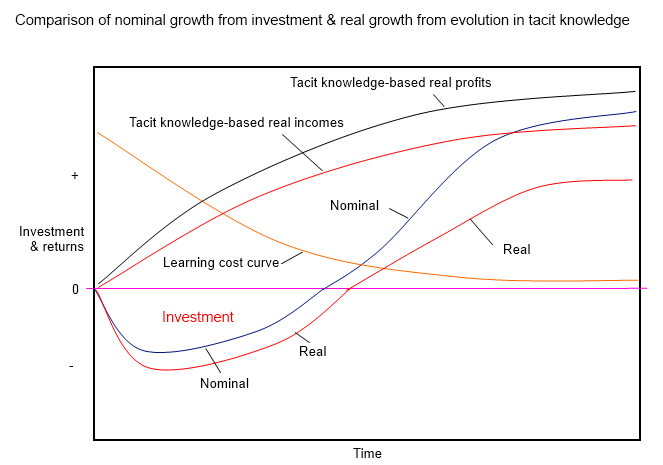
Source: McNeill, H.W., "Price Performance Fiscal Policy - A Real Incomes Approach", Rio de Janeiro, 1976.
|
|
