|
2. Is there a problem?
continuation....
Michal Kalecki's contribution
These social policy-induced effects of instability were associated with company failures and some loss of employment and this frustrated British politicians who did not welcome the negative impact this had upon the image of the government's competence at managing the economy or upon the workings of a centralised welfare state 2 . However, I think it is only right to acknowledge that these types of problems had been precisely predicted to be a potential problem with Keynesianism by the Polish economist Michal Kalecki (1899-1970). I came across some translations of Kalecki's work whilst at Stanford only to discover that he had been publishing most of his works in Polish and that he had predated Keynes in many concepts. For example, he produced highly sophisticated and transparent mathematical treatments of the business cycles and investment lags in several papers which were finally published in English between 1935 and 1954 3 . My own feeling is that Kaleki's contributions deserve a wider acknowledgement than they were given at the time.
A dangerous unresponsiveness of the economy
Unfortunately Keynesianism conditioned politicians to, on the one hand, develop a paternalistic "lead from the font" approach applying broad brush instruments to economic management. The perverse impacts of policy decisions such as corporate failures, unemployment and house repossessions were, as it were, considered to be collateral damage resulting from the "right" policy decisions. This habit of lack of political concern for those prjudiced by the outcomes considered to be of benefit "to the majority" has contributed to the removal of a requisite level of sensitivity to the very specific conditions facing all individual economic units. What was important for policy was the "general condition" or the "average" and such an unrefined basis for setting the governor of the economic engine was particularly crude. This went hand in hand with the increasing political party commitment to centralized planning largely as a basis for levering their political party power. As a result, during the period 1945 through 1975 we in Britain had become used to government being the predominant force in managing the economy. The idea of the economic units making up the economy managing their affairs in such a way as to not require government intervention was considered to be an impossibility or was confused with the specific political philosophy of laissez faire which in the light of steady as you go welfare-statism was considered to be a sort of anarchistic irresponsibility. Flexibility and therefore adaptability of the economy took second place. As a result what passed for an acceptable basis for economic management in fact was undermining the potential responsiveness of the economy to yet-to-be experienced exogenous economic impacts.
Slumpflation as a counter-intuitive shock
A first major demonstration of this significant lack of flexibility in the economy was the slumpflation crisis which was intensified by three major international petroleum price hikes which occurred in 1973, 1979 and 1980. These were all exogenous or externally-generated impacts. Slumpflation 4 - also known as stagflation - was characterised by a combination of simultaneous rises in unemployment and inflation. This for Keynesians was completely counter-intuitive since conventional demand management policy for the economy did not normally have inflation rising with unemployment on the one hand or with demand and output falling on the other. Accordingly the Keynesian bag of policy tools was unable to come up with an instrument able to address this issue, at first, even on theoretical grounds. To address unemployment by higher government expenditure would have made the inflation worse and to reduce demand to lower inflation would have increased unemployment.
Waves of policies
Before the petroleum price shocks of the 1970s the United Kingdom showed a more or less stable relationship between unemployment levels and inflation rates known as the Phillips curve (after William Phillips) and first presented in 1958 as shown on the left as the curve p-c. This meant that raising interest rates or increasing tax to reduce aggregate demand could reduce inflation but at the cost of increasing unemployment. However by 1970 this simple relationship was breaking down and by 1979 had shifted to a specific point which combined high unemployment and inflation, slumpflation (as shown in diagram on the left).
Discussions
I found the period between 1970 and 1975 one where I began to have grave doubts as to the value of the economics I had been taught at university 5 ; or was it that I hadn't understood? Certainly, as far as I was concerned, there seemed to be a gap in analysis in that macroeconomics did not seem to have instruments which addressed basic issues like a massive rise in the price of a vital input to the economy. It was somewhat perplexing how there were no rigorous
theoretical principles within Keynesianism which could be used to fashion instruments to achieve predictable and practical movements in the economy in a desirable direction. In short, policy was lacking. I became somewhat disturbed when I began to realize that I was not the only one having doubts or who perhaps hadn't understood what I was taught. Indeed, one of the most remarkable characteristics of this period was the large number of redundant and highly theoretical exchanges between economists in trying to identify a policy solution. It was also notable than many who should have participated in this quest were very quiet; their silence was deafening. Broadly speaking the discussions that I was aware of tended to be restricted to the macroeconomic and policy level and there was very little discussion on microeconomic questions. This reflected the tradition of macroeconomic policy having become a top down approach used by governments as governors of the economy, as well as of people. There was therefore a notable failure of economists to come to terms with, and try and accommodate, the rich array of mechanisms at the disposal of the managers of economic units working at the microeconomic level to help reduce inflation.
Supply side
Keynesian policies in the UK, could not solve slumpflation. Being aggregate demand orientated, little attention had been given to the combined effect of tax reduction creating supply side incentives which end up stimulating consumption or demand levels in real terms. In other words demand was regarded to be mainly demand pull driven and little consideration was given to supply side driven demand growth. To some extent this was understandable because Britain at that time was going through a period with technology beginning to contribute significant growth potential meaning that output was not directly proportional to the number of people employed in a sector. Thus the old concept of demand pulling up production and employment was being replaced by a newer technological concept of demand stimulating investment in more productive processes employing less people and generating more physical output for a given level of aggregate demand. But as heavy industries began to decline these technological impacts were becoming more evident but policy had not adapted to this reality.
On the other hand, the subsequent period, starting roughly in 1975, was associated with some economists looking at these supply side aspects. There was nothing startling or particularly original about this. The well known learning curve cost effect was, after all, first described in the Second World War in relation aircraft frame production 5 . What was different about the use of this information is that efforts were being made to apply supply side economic realities to the formulation of macroeconomic policies so as to lever, somehow, this microeconomic-based advantage to benefit the whole economy, Indeed, during the 1970s development work on supply side economics seemed to be heading in the direction of seeking microeconomic-driven solutions to the macroeconomic problem.
Reagan's "trickle-down"magic
However, when the US-initiated "supply side economics" became part of the platform for Ronald Reagan's presidential campaign its advance was diverted, to my mind, from becoming a central foundation of the recovery of the US economy. This was caused by cherry picking 6 by the Republicans who relegated this microeconomic element to represent the vehicle for the hoped for economic response based more on laissez faire. In this context is is worth mentioning that the Democrats seem to have accepted the basic supply-side theory as convincing before the Republicans did. It is important to emphasise that the supply side approach, as advanced in the USA, did identify the fundamental weakness in Keynesianism and it went some way to explain why. This was that supply-side derived reductions in unit prices (stimulating real incomes) could be more effective in stimulating demand and growth without inflation than conventional demand pull approaches.
However, in the hands of political parties, in spite of some very clear advocacy in the United States, its logic was relegated more to that of presenting something new to engage others in political debate. This politicisation of the supply-side debate and with President Bush referring to it as "voo-doo" economics, the existing and competing economic schools failed to give sufficient weight to its importance and accordingly the need to develop a comprehensive economic theory embodying the supply side considerations as the central theme was not entertained nor considered adequately.
In the end those more disposed to not discover the potential contribution of microeconomic, or supply side, decisions seemed to win the day and a somewhat rapidly introduced solution to this quandry was that the macroeconomic approach of Monetarism took up centre stage. This came "ready-made" with a strong American intellectual and political baggage in the form of academic institutional support and some articulate spokesmen. The best known at the time was the American economist Milton Friedman. This mixed policy bag combining supply side and Monetarism was rolled out as what came to be referred to as "trickle down economics" under a new President Reagan. It was also subsequently referred to as Reaganomics.
Political cherry picking
The reality was that by improving incentives at the corporate level through tax reduction the aggregate supply level could increase in association with lower unit prices. Again, political interferences and cherry picking 7 succeeded in obscuring this point with much debate being taken up on the issue of what would happen to government revenues, an issue which became a dominant concern of the American Congress. Some confusion surrounds the degree to which policy was based upon the relationship attributed to the American economist Arthur Laffer which appeared in 1978 and known as the Laffer Curve (see left "“ supposedly launched not in an obscure economic treatise but apparently first appeared on a restaurant napkin). In the end, the Republican administration starting in 1981, had become more attracted by the concept of tax cuts as a stimulus to supply as opposed to relying upon the Laffer effect to make up revenue shortfalls through the expected growth in the economy resulting from a response on the part of the corporate sector taking advantage of the associated supply side effects.
Paul Craig Roberts, writing in The Independent Review 10 , emphasised that President Reagan's economic programme 11 was not based on the Laffer Curve assumptions of a tax cut paying for itself. He states that the administration was assuming that for every dollar lost in tax would represent a dollar lost in revenue, that is, tax cuts were expected to slow the growth in revenues. Under Reagan inadequate attention was paid to how to compensate falls in provisions previously supported by government revenue and therefore, because revenues did not recover but rather a massive pubic sector debt accumulated; it tripled from around $930 billion to U$3,233 billion in just 10 years. As a result many came to consider "trickle down" economics as code for helping the rich at the expense of the poor who relied on large state and federal programmes. The outcome was that whereas supply side economics as applied by the Reagan administration was successful in reducing inflation and stimulating growth there seemed to be insufficient attention paid to trying to identify policy levers to sustain the momentum of supply side benefits so as to try and spread the effects to lower income groups. In the American political environment a common perception, encouraged by the Democratic party, was that the tax breaks were gifts to the Republican party constituency which was better off and all of this caused a significant rise in government debt and a worsening of the situation of the poor. Indeed, President Clinton used "balancing of the debt" and improving provisions for the poor as key planks in his bid for the presidency.
No matter where people's political philosophies rest there was no doubt that one of the results was that the gaps between rich and poor both in the USA and subsequently in the UK increased during the 1980s to mid 1990s.
"Trickle-down" magic casts its spell
By 1981, Margaret Thatcher's government also adopted a similar approach. In Britain, just as in the USA, little time was devoted to explaining the significance of supply side and in particular its significance to Geoffrey Howe's budget of 1981. As a result few understood what was afoot including many academics. Although many remain in denial about this reality, the lack of convincing counter arguments was more than apparent to anyone interested in the topic. It is regrettable that the government failed to communicate, more effectively, its justifications for its policies. In contrast to the 1960s when academics advising governments would engage one another in the media, sometimes in terms intelligible to the layman, the 1980s was notable in a lack of clear articulation of issues within the public arena designed to test out the common sense of their approach.
A United Kingdom guided by visions and leaps of faith?
Although today the supply-siders will argue that their message was clear and had been understood. I can state with some qualification that in the United Kingdom the message concerning the full potential implications of the supply side had only got through to a few people 1 . Indeed, during 1980 and 1981 the exchanges between academic economists intensified around two opposing "schools" marked by discussions asserting the relative merits of Monetarism and Keynesianism as the possessors of the means to resolve slumpflation in the United Kingdom. These exchanges degenerated into what one can only describe as invitation to the other side to take leaps of faith into the embrace of the opposing side. What was missing from these exchanges was a very obvious lack of any detailed review of the potential contributions of the supply side.
Deficient policy exposition
It was becoming clear that the Conservative government was aware of the supply side issues, at least the terms cropped up in their vocabulary but their willingness to engage the public and even the media to express what they understood this to be was not there. There was in fact little attempt to engage the public on this issue. Margaret Thatcher had introduced a system of "special advisers' including, for example at that time, Professor Alan Walters. The problem with such an advisory system was not the adviser but rather this system was not conducive to easy articulation and dissemination of thinking outside specialist journals or media not widely read by the general public. However, this form of advice, especially within the fields of government finance and economics was to be taken up by subsequent governments including those of the Labour party with the same negative impact on effective policy concept dissemination.
Ye bearers of ill tidings
Even as far back as 1981, if the electorate had been left out of communications loop, so it would seem had British economists, or at least, some of them. This became very clear when some 364 economists, largely from British academia, signed a letter sent to the The Times Newspaper in 1981 (content shown on the right). This was in response to the Conservative government's 1981 Budget which was not based on any known Keynesian notion of policy but essentially raised taxation and lowered interest rates.
The letter to the Times asserted that the Budget was not based on any known economic theory, that the outcome would deepen the depression, erode the industrial base of our economy and threaten its social and political stability, and that there were alternatives. What was remarkable in this note was that the economists did not in fact state what aspect of the Budget was wrong but simply referred to the fact that it contravened unspecified theories.
Although, at the time, I could sense and understand the feelings expressed in that letter it did not pass for more than a political statement. It was very much along the lines of exchanges within the Britain's political party adversarial system where one states that the other party is wrong but fails to suggest a better option.
One peculiar presumption on the part of the signatories was their apparent claim that as a body they were cognizant of all economic theory and indeed aware of all viable options. Any reader accepting this unlikely state of affairs could at least have expected one or two alternative policy options to have been added as an appendix to the letter. In the event they failed to come up with any. It was as if they had momentarily forgotten that it was the prolonged failure of any convincing options being presented, on my count during a period of some five years, that had stimulated supply side analysis on the one hand and the increasing rivalry between contending schools to gain the ear of a government who seemed keen to supplant Keynesianism by some variant of Monetarism.
The British government responded to the letter by pointing out their faith in Monetarism and adding " [as far] as output and employment are concerned, the Government's supply side policies have been designed with the objective of raising both output and employment specifically in mind.... directed .. to fostering the more effective working of market forces and the restoration of incentive." and that [without mentioning the USA] "...Countries pursuing policies broadly of the kind being implemented here are those with the strongest industrial base."
As things turned out, the letter writers seemed to have been correct in that in the short to medium term (0-3 years) the approach adopted deepened the depression, did erode the industrial base of our economy and for a short while seemed to threaten social and political stability. But had they also forgotten that such policy-induced perversions had occurred under Keynesian policies in the past. On the other hand some would argue that many current social ills in Britain stem from that period. On balance the position and action of the government of the day, following a difficult but relatively short period, turned out to be roughly correct.
Supply side debate
Ever since this policy package was introduced there have been endless debates which have lasted to this day concerning why Britain's economy recovered. It is notable that these discussions, like the discussions following the Reagan years, lip service is paid to "supply side effects", if one looks hard enough, but I am not aware of anyone really analyzing its specific contribution, if any. As before, the discussions have continued to be a Keynesian-Monetarist debate as if a significant segment of the economic world spins within a time warp.
Lately, and fortunately, this debate has splintered and as a result is becoming, to my mind, more interesting and relevant because it is shifting towards one between supply side issues on the one hand and Monetarists on the other and a reviving Keynesian voice coming over the horizon. I am not one who discounts Keynesian relationships as a very broad brush explanation for how the economy works but I do have doubts as to its efficacy as a basis for macroeconomic management.
And Monetarism?
After 27 years it is notable that Monetarism has been the vehicle of policy in all subsequent British governments including those run by the Labour party who, up until the early 1970s, had been die hard Keynesians. Unfortunately, like the post-Reagan period in the USA, all subsequent British governments in applying Monetarism came to regard the "financial system" and money as the predominant determinants of economic stability and reference to "supply side" components effectively petered out. And so, like Keynesianism before it, the current brand of Monetarism is beginning to show the very same limitations that Keynesianism suffered from in the 1970s.
Coming to the issue
There are very specific alterations in the structure of the economies of the 1920s, and then during two 30 year transitions covering 1945-1975 and then 1975-2012. In basic terms these differences are quite obvious and they relate to the growth in the plasticity of technology and in the role of financial debt in economic activities. Thus in the 1920s the labour-intensive nature of economic production made output roughly proportional to demand and therefore employment to output. This was the fundamental relationship identified by Keynes as being something which could be levered to sustain full employment. During the period covering 1945 to 1975 this seemed to work. However there was something happeneing in the fields of technology and technique. This was that the direct relationships between demand, output and employment were breaking down simply because technological development enabled companies to increase physical output whilst employing less labour. This was an obvious effect of automation and the development of supply chain efficiencies being introduced in a somewhat crude form. Thus the Keynesian model of regarding the economy as a sort of motor with a fixed gear ratio between demand, output and emploment to be manipulated by a control over demand was beginning to break down. This reality was brought home with the impact of a sudden rise in petroleum prices. This particular input cost crisis affected a complete economic subsector which could not react in the short term and only with difficulty in the medium term to take steps towards substitution of petroleum or its more efficient use. This is why neither Keynesianism not Monetarism could do much to address the issue. Clearly being an issue to be resolved through technical means it was a supply side issue and could only be solved through proactive moves at the microeconomic level following the time schedules imposed on all innovation and investment cycle affecting a whole economy and taking into account such things as new vehicle and engine design as well as ways and means of economizing on fuel use. If one accepts that the diversity of the situations facing economic actors is very large then one needs to appreciate that the time taken for companies to re-equip and regain a position of reasonable productivity, in spite of high petroleum prices, was going to take a minimum of 10 years for some companies and up to 20 years for such innovations to affect most economic units 12 . The reality is that such timeframes cannot be supported by the current British politial system where parties and politicians are looking for short term solutions as a basis for securing their place in Parliament.
Fortunately such changes took place but with little support from KM policies.
After 27 years it is notable that Monetarism has been the vehicle of policy in all subsequent British governments including those run by the Labour party whoPost 1975 was associated with a massive growth in debt based investment, this was followed by increasing levels of debt exposure in the housing finance sectors and finally the demand levels in the economy were becoming more sensitive to consumer debt than to the old Keynesian relationships between taxation and government expenditure. The growth in Montarism saw the rise of financial indicators as guides to macroeconomic policy decisions. Part of this process is the advancing of funds to banks at interest rates below the interbank rate. It is this interest rate which establishes the floor rate of interest. This process has placed private banks in a central and preferential position for the management of macroeconomic policy.
Interest rate setting has become the preferred method to moderate economic activiy. The high levels of debt based consumer expenditure, asset purchase through long term loans such as house mortgages and corporate debt has had three effects during the last 30 years:
In the 1970s the Keynesian system relied upon a similar set of associations:
After 27 years it is notable that Monetarism has been the vehicle of policy in all subsequent British governments including those run by the Labour party whoThe common weak point is that if the source of funds creating the policy levers dry up then the policy begins to lose influence and can fail. Thus with the petroleum price hikes the cash flows from which to draw taxation and thereby spend declined drastically because of falls in profits as well as real incomes, or purchasing power, on the parts of those relying upon petroleum and petroleum derivatives. A large proportion of observed "inflation" was related to the multiplier effect of the petroleum price hikes. Since the government's fiscal levers were weakened as a reduction in the tax base and lowering interest rates threatened to increase inflation the Keynesians imagined there was no graceful way out of the predicament.
In the same way, having made banks central to macroeconomic policy the cash flows for paying off debt need to remain stable for macroeconomic policy to work. Because banks have made use of investment instruments based upon US-based mortgage products, which were not correctly asessed for risk, there seem to have been a large number of investment portfolios held by banks which are facing a declining cash flow status. This is the result of the incapacity of some original borrowers to pay and necessary repossessions taking place on properties whose value, having deducted the costs of disposal, are less than the outstanding debt. As a result the government cannot transmit the effects of policy decisions through the banking system because the banking system has become an unreliable agent for the transmission of desired policy effects.
Agreeing that there is a problem, how can it be solved?
Probably enough has been said for us to agree that there is a problem with macreoeconomic policy as applied in 1945 through 1975 and then as applied between 1980 through 2012 and the overall points of failure are very similar in that if the nominal cash flow is declining on any economic component or agent upon which the macroeconomis policy relies, then the policy does not work and will not work. The problems do not just lie there but can be summed up in two related missing elements from the policy approach:
The problem with KM policies is that they make use of component indices as opposed to prime 8 indices as objectives of policy. This means that they use dependent variables which are able to move in mutually contradictory ways and create a constant diversion of policy chasing the most significant current indicator. This was explained in a paper published in 1981 as follows 9
Before identifying such a prime index it is necessary to clarify what is meant by policy traction. This is explained in the same paper thus:
Having explained traction then the necessary properties of the prime index become more evident. This is explained in the same paper:
It is not the purpose of this brief to analyse the very complex problem of measuring real incomes since this will be covered in moe detail in other briefs. It is sufficient to note that:
An outstanding issue
An outstanding issue remains the odd confusion, or even antagonism, between taxation and spending as macroeconomic policy instruments and taxation as raising revenues to support essential public services and spending as part of the normal process of implementing and sustaining them. This is explained follows:
Following briefs
Much remains to be explained. For example how would the use of real incomes, as the prime index, operate in a fiscal system and what would be the impact upon inflation and interest rates? These important issues will be addressed in subsequent briefs.
1 During 1981 I discussed supply side issues and real incomes policy in particular with a large number of people giving talks to local groups (Portsmouth) as well as having meetings with relevant representatives of the main British political parties and the trades unions based in London. The experience was quite revealing. The Labour party response was to refer me to the Trades Union Council. Len Murray who was the head of the Trades Union Council would only consider proposals which supported their agreed and established position. On the part of the Conservatives I received very useful feedback from some advisers but one of their principle economists, who was also an MP, had some difficulty in, I felt, understanding the concepts involved. In addition, a rather bizarre "sticking point" in our meeting was his insistence that Britain could not have a growth rate of in excess of 0.75% per annum! I had provided impact examples for price performance fiscal policy (Real Incomes policy) which achieved growth rates well above this. The MP who showed most interest and, indeed, I felt had read and understood the material I had cirulated was Richard Wainwright a Liberal MP and at the time their shadow on economic affairs. He was resistant to the approach because he considered the changes required would be quite major; he was, of course, right.
One of the alarming aspects of this sort of experience was the ability politicians and the TUC representative to cherry pick 6 the policy proposals presented is such a way that they would select the elements which seemed to be supportive of their existing policies so as to render the overall model useless unless the rest was also used. And this was during a period when most admitted that we were going through an economic crisis. The only person who did not cherry pick was Richard Wainright.
A very strong impression I took from these meetings was that few so-called decision-makers were really prepared to think on their own feet about a different approach to economic policy which was not a product of the prevailing "schools". On the other hand, the local encounters I had on this topic were extremely productive and interesting and there was far more understanding since most participants were not totally aware of the prevailing schools of thought which, I might add, seems to be the situation today.
2 The British welfare state, we should recall, found its roots in the pioneering work of William Beveridge working with the Liberals as far back as 1909.
3 In mentioning his contributions in the US academic environment of the late 1960s, the fact that he was classed as a Marxist economist seemed to cause many to discount his contributions. On the other hand, Kaleki's work on class, income distribution and imperfect competition seems to have influenced a whole generation of economists including UK-based Cambridge Keynesians such as Goodwin, Harrod, Kaldor, Robinson and Shackle some of whom advised different Labour governments.
4 I use the term slumpflation because it is more descriptive and ties in with Keynes' own use of the word slump. Slump was the common English word used by those who experienced the unemployment of the Great Depression and who, for example, participated in the Jarrow March from Jarrow down to London in 1936; slump meant high unemployment and no production. Thus, stagflation, the combination of no demand, reduced output, high unemployment and high inflation.
5 There are many supply side factors which determine the final unit price of production of which learning is an important factor. For early work on the learning effect see: "Factors affecting the cost of airplanes", Wright, T.P., Journal of Aeronautical Science, February 1936, pp 122-128 and associated factors determining supply side benefits on demand, "On the Problem of Technological Ignorance Amongst KM-Economists - Supply as demand", McNeill, H.W., December, 1981, HPC, ISBN: 978-0-907833-10-9
6 A point I will return to later in this tutorial is that I have always sensed that solutions were not identified largely as a result of a collision of two characteristics of economics. One was in university teaching it was broken down into separate domains of macroeconomics and microeconomics with national accounts being the boring bit which was dispatched in the first lectures on macroeconomics. This seemed to lead to a tendency for economists to specialise along these lines whereas a generalist approach combining competence in all lines seems to have been what was needed for problem-solving. The other was the division of economics into rival "schools of economic thought", a state of affairs which still persists.
7 Cherry picking in this sense is the selection of those parts of a more comprehensive proposition which appeal to a person's preconceived preferences. It is a practice very commonly associated with politicians who serve policial parties resulting from their willingness to be intellectually-shackled to re-determined party policy or a political philosophy. This can lead to their assuming they are supporting their political interests but quite often by dismantling a proposition the overall viability collapses.
8 Prime is used here in the descriptive sense of being the most important or comprehensive. There are ways to classify variables according to their cross-dependencies and prime indices can be considered to be ones which "contain" the dependent variance of the variable contained within the prime index; this is the subject of a separate brief.
9 "Notes on Real Incomes Policy", McNeill, H.W., Charter House Essays in Political Economy, Real Incomes Series, December, 1981, HPC, ISBN:978-0-907833-05-5
10 My Time with Supply-Side Economics, Roberts, P.C., The Independent Review, V. VII, No. 3, Winter 2003, ISSN 1086-1653, pp. 393-397.
11 A Program for Economic Recovery, 18th February, 1981.
12 I have received queries as to why I state the time of response and recovery from the price shocks in petroleum to be so long. This is related to the state of the art technology and the specific feasibility of introducing technological adjustments geared to specific corporate capital investment cycles. This issue is explained in more detail in the section on innovation where the example of information technology is used to explain this delay in take up and which, for example can reduce a specific applications which can gain something like 200% in productivity growth being reduced to an overall annual GNP impact of less than 1%.
©1975-2012 Hector McNeill This tutorial series has been prepared by Hector McNeill based upon articles, papers and reports on research & development on the Real Incomes Approach. The series is suitable for anyone interested in an objective analysis of the structure of economies with a view to identifying appropriate policy objectives and tools. Hector McNeill is the Director of SEEL, the Systems Engineering Economics Lab.
These social policy-induced effects of instability were associated with company failures and some loss of employment and this frustrated British politicians who did not welcome the negative impact this had upon the image of the government's competence at managing the economy or upon the workings of a centralised welfare state 2 . However, I think it is only right to acknowledge that these types of problems had been precisely predicted to be a potential problem with Keynesianism by the Polish economist Michal Kalecki (1899-1970). I came across some translations of Kalecki's work whilst at Stanford only to discover that he had been publishing most of his works in Polish and that he had predated Keynes in many concepts. For example, he produced highly sophisticated and transparent mathematical treatments of the business cycles and investment lags in several papers which were finally published in English between 1935 and 1954 3 . My own feeling is that Kaleki's contributions deserve a wider acknowledgement than they were given at the time.
A dangerous unresponsiveness of the economy
Unfortunately Keynesianism conditioned politicians to, on the one hand, develop a paternalistic "lead from the font" approach applying broad brush instruments to economic management. The perverse impacts of policy decisions such as corporate failures, unemployment and house repossessions were, as it were, considered to be collateral damage resulting from the "right" policy decisions. This habit of lack of political concern for those prjudiced by the outcomes considered to be of benefit "to the majority" has contributed to the removal of a requisite level of sensitivity to the very specific conditions facing all individual economic units. What was important for policy was the "general condition" or the "average" and such an unrefined basis for setting the governor of the economic engine was particularly crude. This went hand in hand with the increasing political party commitment to centralized planning largely as a basis for levering their political party power. As a result, during the period 1945 through 1975 we in Britain had become used to government being the predominant force in managing the economy. The idea of the economic units making up the economy managing their affairs in such a way as to not require government intervention was considered to be an impossibility or was confused with the specific political philosophy of laissez faire which in the light of steady as you go welfare-statism was considered to be a sort of anarchistic irresponsibility. Flexibility and therefore adaptability of the economy took second place. As a result what passed for an acceptable basis for economic management in fact was undermining the potential responsiveness of the economy to yet-to-be experienced exogenous economic impacts.
Slumpflation as a counter-intuitive shock
A first major demonstration of this significant lack of flexibility in the economy was the slumpflation crisis which was intensified by three major international petroleum price hikes which occurred in 1973, 1979 and 1980. These were all exogenous or externally-generated impacts. Slumpflation 4 - also known as stagflation - was characterised by a combination of simultaneous rises in unemployment and inflation. This for Keynesians was completely counter-intuitive since conventional demand management policy for the economy did not normally have inflation rising with unemployment on the one hand or with demand and output falling on the other. Accordingly the Keynesian bag of policy tools was unable to come up with an instrument able to address this issue, at first, even on theoretical grounds. To address unemployment by higher government expenditure would have made the inflation worse and to reduce demand to lower inflation would have increased unemployment.
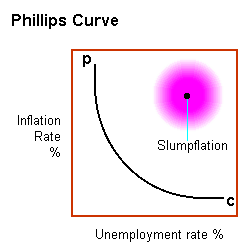 |
Before the petroleum price shocks of the 1970s the United Kingdom showed a more or less stable relationship between unemployment levels and inflation rates known as the Phillips curve (after William Phillips) and first presented in 1958 as shown on the left as the curve p-c. This meant that raising interest rates or increasing tax to reduce aggregate demand could reduce inflation but at the cost of increasing unemployment. However by 1970 this simple relationship was breaking down and by 1979 had shifted to a specific point which combined high unemployment and inflation, slumpflation (as shown in diagram on the left).
Discussions
I found the period between 1970 and 1975 one where I began to have grave doubts as to the value of the economics I had been taught at university 5 ; or was it that I hadn't understood? Certainly, as far as I was concerned, there seemed to be a gap in analysis in that macroeconomics did not seem to have instruments which addressed basic issues like a massive rise in the price of a vital input to the economy. It was somewhat perplexing how there were no rigorous
|
Supply side
Keynesian policies in the UK, could not solve slumpflation. Being aggregate demand orientated, little attention had been given to the combined effect of tax reduction creating supply side incentives which end up stimulating consumption or demand levels in real terms. In other words demand was regarded to be mainly demand pull driven and little consideration was given to supply side driven demand growth. To some extent this was understandable because Britain at that time was going through a period with technology beginning to contribute significant growth potential meaning that output was not directly proportional to the number of people employed in a sector. Thus the old concept of demand pulling up production and employment was being replaced by a newer technological concept of demand stimulating investment in more productive processes employing less people and generating more physical output for a given level of aggregate demand. But as heavy industries began to decline these technological impacts were becoming more evident but policy had not adapted to this reality.
On the other hand, the subsequent period, starting roughly in 1975, was associated with some economists looking at these supply side aspects. There was nothing startling or particularly original about this. The well known learning curve cost effect was, after all, first described in the Second World War in relation aircraft frame production 5 . What was different about the use of this information is that efforts were being made to apply supply side economic realities to the formulation of macroeconomic policies so as to lever, somehow, this microeconomic-based advantage to benefit the whole economy, Indeed, during the 1970s development work on supply side economics seemed to be heading in the direction of seeking microeconomic-driven solutions to the macroeconomic problem.
Reagan's "trickle-down"magic
However, when the US-initiated "supply side economics" became part of the platform for Ronald Reagan's presidential campaign its advance was diverted, to my mind, from becoming a central foundation of the recovery of the US economy. This was caused by cherry picking 6 by the Republicans who relegated this microeconomic element to represent the vehicle for the hoped for economic response based more on laissez faire. In this context is is worth mentioning that the Democrats seem to have accepted the basic supply-side theory as convincing before the Republicans did. It is important to emphasise that the supply side approach, as advanced in the USA, did identify the fundamental weakness in Keynesianism and it went some way to explain why. This was that supply-side derived reductions in unit prices (stimulating real incomes) could be more effective in stimulating demand and growth without inflation than conventional demand pull approaches.
|
In the end those more disposed to not discover the potential contribution of microeconomic, or supply side, decisions seemed to win the day and a somewhat rapidly introduced solution to this quandry was that the macroeconomic approach of Monetarism took up centre stage. This came "ready-made" with a strong American intellectual and political baggage in the form of academic institutional support and some articulate spokesmen. The best known at the time was the American economist Milton Friedman. This mixed policy bag combining supply side and Monetarism was rolled out as what came to be referred to as "trickle down economics" under a new President Reagan. It was also subsequently referred to as Reaganomics.
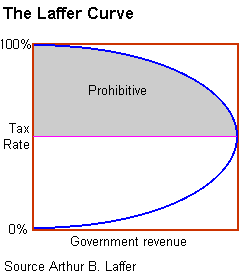 |
The reality was that by improving incentives at the corporate level through tax reduction the aggregate supply level could increase in association with lower unit prices. Again, political interferences and cherry picking 7 succeeded in obscuring this point with much debate being taken up on the issue of what would happen to government revenues, an issue which became a dominant concern of the American Congress. Some confusion surrounds the degree to which policy was based upon the relationship attributed to the American economist Arthur Laffer which appeared in 1978 and known as the Laffer Curve (see left "“ supposedly launched not in an obscure economic treatise but apparently first appeared on a restaurant napkin). In the end, the Republican administration starting in 1981, had become more attracted by the concept of tax cuts as a stimulus to supply as opposed to relying upon the Laffer effect to make up revenue shortfalls through the expected growth in the economy resulting from a response on the part of the corporate sector taking advantage of the associated supply side effects.
Paul Craig Roberts, writing in The Independent Review 10 , emphasised that President Reagan's economic programme 11 was not based on the Laffer Curve assumptions of a tax cut paying for itself. He states that the administration was assuming that for every dollar lost in tax would represent a dollar lost in revenue, that is, tax cuts were expected to slow the growth in revenues. Under Reagan inadequate attention was paid to how to compensate falls in provisions previously supported by government revenue and therefore, because revenues did not recover but rather a massive pubic sector debt accumulated; it tripled from around $930 billion to U$3,233 billion in just 10 years. As a result many came to consider "trickle down" economics as code for helping the rich at the expense of the poor who relied on large state and federal programmes. The outcome was that whereas supply side economics as applied by the Reagan administration was successful in reducing inflation and stimulating growth there seemed to be insufficient attention paid to trying to identify policy levers to sustain the momentum of supply side benefits so as to try and spread the effects to lower income groups. In the American political environment a common perception, encouraged by the Democratic party, was that the tax breaks were gifts to the Republican party constituency which was better off and all of this caused a significant rise in government debt and a worsening of the situation of the poor. Indeed, President Clinton used "balancing of the debt" and improving provisions for the poor as key planks in his bid for the presidency.
No matter where people's political philosophies rest there was no doubt that one of the results was that the gaps between rich and poor both in the USA and subsequently in the UK increased during the 1980s to mid 1990s.
"Trickle-down" magic casts its spell
By 1981, Margaret Thatcher's government also adopted a similar approach. In Britain, just as in the USA, little time was devoted to explaining the significance of supply side and in particular its significance to Geoffrey Howe's budget of 1981. As a result few understood what was afoot including many academics. Although many remain in denial about this reality, the lack of convincing counter arguments was more than apparent to anyone interested in the topic. It is regrettable that the government failed to communicate, more effectively, its justifications for its policies. In contrast to the 1960s when academics advising governments would engage one another in the media, sometimes in terms intelligible to the layman, the 1980s was notable in a lack of clear articulation of issues within the public arena designed to test out the common sense of their approach.
A United Kingdom guided by visions and leaps of faith?
Although today the supply-siders will argue that their message was clear and had been understood. I can state with some qualification that in the United Kingdom the message concerning the full potential implications of the supply side had only got through to a few people 1 . Indeed, during 1980 and 1981 the exchanges between academic economists intensified around two opposing "schools" marked by discussions asserting the relative merits of Monetarism and Keynesianism as the possessors of the means to resolve slumpflation in the United Kingdom. These exchanges degenerated into what one can only describe as invitation to the other side to take leaps of faith into the embrace of the opposing side. What was missing from these exchanges was a very obvious lack of any detailed review of the potential contributions of the supply side.
Deficient policy exposition
It was becoming clear that the Conservative government was aware of the supply side issues, at least the terms cropped up in their vocabulary but their willingness to engage the public and even the media to express what they understood this to be was not there. There was in fact little attempt to engage the public on this issue. Margaret Thatcher had introduced a system of "special advisers' including, for example at that time, Professor Alan Walters. The problem with such an advisory system was not the adviser but rather this system was not conducive to easy articulation and dissemination of thinking outside specialist journals or media not widely read by the general public. However, this form of advice, especially within the fields of government finance and economics was to be taken up by subsequent governments including those of the Labour party with the same negative impact on effective policy concept dissemination.
|
Even as far back as 1981, if the electorate had been left out of communications loop, so it would seem had British economists, or at least, some of them. This became very clear when some 364 economists, largely from British academia, signed a letter sent to the The Times Newspaper in 1981 (content shown on the right). This was in response to the Conservative government's 1981 Budget which was not based on any known Keynesian notion of policy but essentially raised taxation and lowered interest rates.
The letter to the Times asserted that the Budget was not based on any known economic theory, that the outcome would deepen the depression, erode the industrial base of our economy and threaten its social and political stability, and that there were alternatives. What was remarkable in this note was that the economists did not in fact state what aspect of the Budget was wrong but simply referred to the fact that it contravened unspecified theories.
Although, at the time, I could sense and understand the feelings expressed in that letter it did not pass for more than a political statement. It was very much along the lines of exchanges within the Britain's political party adversarial system where one states that the other party is wrong but fails to suggest a better option.
One peculiar presumption on the part of the signatories was their apparent claim that as a body they were cognizant of all economic theory and indeed aware of all viable options. Any reader accepting this unlikely state of affairs could at least have expected one or two alternative policy options to have been added as an appendix to the letter. In the event they failed to come up with any. It was as if they had momentarily forgotten that it was the prolonged failure of any convincing options being presented, on my count during a period of some five years, that had stimulated supply side analysis on the one hand and the increasing rivalry between contending schools to gain the ear of a government who seemed keen to supplant Keynesianism by some variant of Monetarism.
The British government responded to the letter by pointing out their faith in Monetarism and adding " [as far] as output and employment are concerned, the Government's supply side policies have been designed with the objective of raising both output and employment specifically in mind.... directed .. to fostering the more effective working of market forces and the restoration of incentive." and that [without mentioning the USA] "...Countries pursuing policies broadly of the kind being implemented here are those with the strongest industrial base."
As things turned out, the letter writers seemed to have been correct in that in the short to medium term (0-3 years) the approach adopted deepened the depression, did erode the industrial base of our economy and for a short while seemed to threaten social and political stability. But had they also forgotten that such policy-induced perversions had occurred under Keynesian policies in the past. On the other hand some would argue that many current social ills in Britain stem from that period. On balance the position and action of the government of the day, following a difficult but relatively short period, turned out to be roughly correct.
Supply side debate
Ever since this policy package was introduced there have been endless debates which have lasted to this day concerning why Britain's economy recovered. It is notable that these discussions, like the discussions following the Reagan years, lip service is paid to "supply side effects", if one looks hard enough, but I am not aware of anyone really analyzing its specific contribution, if any. As before, the discussions have continued to be a Keynesian-Monetarist debate as if a significant segment of the economic world spins within a time warp.
Lately, and fortunately, this debate has splintered and as a result is becoming, to my mind, more interesting and relevant because it is shifting towards one between supply side issues on the one hand and Monetarists on the other and a reviving Keynesian voice coming over the horizon. I am not one who discounts Keynesian relationships as a very broad brush explanation for how the economy works but I do have doubts as to its efficacy as a basis for macroeconomic management.
And Monetarism?
|
Coming to the issue
There are very specific alterations in the structure of the economies of the 1920s, and then during two 30 year transitions covering 1945-1975 and then 1975-2012. In basic terms these differences are quite obvious and they relate to the growth in the plasticity of technology and in the role of financial debt in economic activities. Thus in the 1920s the labour-intensive nature of economic production made output roughly proportional to demand and therefore employment to output. This was the fundamental relationship identified by Keynes as being something which could be levered to sustain full employment. During the period covering 1945 to 1975 this seemed to work. However there was something happeneing in the fields of technology and technique. This was that the direct relationships between demand, output and employment were breaking down simply because technological development enabled companies to increase physical output whilst employing less labour. This was an obvious effect of automation and the development of supply chain efficiencies being introduced in a somewhat crude form. Thus the Keynesian model of regarding the economy as a sort of motor with a fixed gear ratio between demand, output and emploment to be manipulated by a control over demand was beginning to break down. This reality was brought home with the impact of a sudden rise in petroleum prices. This particular input cost crisis affected a complete economic subsector which could not react in the short term and only with difficulty in the medium term to take steps towards substitution of petroleum or its more efficient use. This is why neither Keynesianism not Monetarism could do much to address the issue. Clearly being an issue to be resolved through technical means it was a supply side issue and could only be solved through proactive moves at the microeconomic level following the time schedules imposed on all innovation and investment cycle affecting a whole economy and taking into account such things as new vehicle and engine design as well as ways and means of economizing on fuel use. If one accepts that the diversity of the situations facing economic actors is very large then one needs to appreciate that the time taken for companies to re-equip and regain a position of reasonable productivity, in spite of high petroleum prices, was going to take a minimum of 10 years for some companies and up to 20 years for such innovations to affect most economic units 12 . The reality is that such timeframes cannot be supported by the current British politial system where parties and politicians are looking for short term solutions as a basis for securing their place in Parliament.
Fortunately such changes took place but with little support from KM policies.
|
Interest rate setting has become the preferred method to moderate economic activiy. The high levels of debt based consumer expenditure, asset purchase through long term loans such as house mortgages and corporate debt has had three effects during the last 30 years:
- increased sensitivity of aggregate demand to interest rates
- increased reliance upon stability in cash flows being used to repay debt
- a relative decine in the significance of fiscal elements (taxation and spending) as macroeconomic policy instruments
In the 1970s the Keynesian system relied upon a similar set of associations:
- a sensitivity of aggregate demand to taxation or expenditure
- taxation and therefore expenditure depended upon stability in cash flows being used to pay tax
- in relative terms the elements of taxation and spending were the main macroeconomic policy instruments
|
In the same way, having made banks central to macroeconomic policy the cash flows for paying off debt need to remain stable for macroeconomic policy to work. Because banks have made use of investment instruments based upon US-based mortgage products, which were not correctly asessed for risk, there seem to have been a large number of investment portfolios held by banks which are facing a declining cash flow status. This is the result of the incapacity of some original borrowers to pay and necessary repossessions taking place on properties whose value, having deducted the costs of disposal, are less than the outstanding debt. As a result the government cannot transmit the effects of policy decisions through the banking system because the banking system has become an unreliable agent for the transmission of desired policy effects.
Agreeing that there is a problem, how can it be solved?
Probably enough has been said for us to agree that there is a problem with macreoeconomic policy as applied in 1945 through 1975 and then as applied between 1980 through 2012 and the overall points of failure are very similar in that if the nominal cash flow is declining on any economic component or agent upon which the macroeconomis policy relies, then the policy does not work and will not work. The problems do not just lie there but can be summed up in two related missing elements from the policy approach:
- the lack of a prime index
- the lack of policy traction
The problem with KM policies is that they make use of component indices as opposed to prime 8 indices as objectives of policy. This means that they use dependent variables which are able to move in mutually contradictory ways and create a constant diversion of policy chasing the most significant current indicator. This was explained in a paper published in 1981 as follows 9
| "Unruly indicators Although aggregate demand is considered to be the "governor" of the economy, at any particular time in the policy cycle different indicators will rise to dominate the current attention of policy makers. Thus unemployment might become something of concern, or attention might be deflected by rising inflation. On the other hand declining investment might be tied to interest rates having been set at too high a level. Things can get out of hand when several indicators rear up simultaneously as issues for current attention. Thus our experience with slumpflation is a good example of a combination of everything going "the wrong way", that is falling demand, employment and output with rising inflation. The quest for a common cause To secure predictability for policy outcomes it is necessary to identify an economic measurement or a prime index which is acknowledged to represent the state of affairs facing everyone in the economy before a policy decision is implemented. Such a prime indicator needs to be comprehensive enough to remain the priority indicator no matter what the outcome of the policy implemented. There is a need to get rid of the mixed bag of unruly indicators which quite naturally jostle for priority position in attracting the attention of policy-makers. This diversionary impact on policy needs to be overcome somehow. There is a need to select a prime indicator which accommodates all such possible sub-indicators of significance. The objective of sound policy should then become the effort to sustain or move the prime index in the desired direction. The challenge is to avoid the KM problems of indices "moving the wrong way" or "moving too far" or even "not at all" in spite of policy implementation. " |
Before identifying such a prime index it is necessary to clarify what is meant by policy traction. This is explained in the same paper thus:
| "The quest for policy traction Macroeconomic policy needs to be designed in such a way as to gain more predictability of outcomes and, in particular in difficult circumstances such as commodity price shocks or failures of significant financial intermediaries. In order to gain more predictability policy needs to have a more direct control over the direction and extent of policy target movements. Put another way, current policy instruments used do not gain enough traction over the decisions of companies and individuals within an economy to shift activities towards a mutually beneficial state. However, a transition to this state of affairs should not be accompanied by the current assumptions that macroeconomic policy can continue to operate on the basis of the expensive luxury of monopoly interventions in markets. For any policy to gain the level of traction necessary to secure a direct control over a prime index (target variable), it needs to be acknowledged as one which represents a common objective of everyone in the policy constituency, all economic units, in short the economy and the electorate of the United Kingdom. " |
Having explained traction then the necessary properties of the prime index become more evident. This is explained in the same paper:
| "A relevant measure & a policy with traction A target variable which should find unanimous acceptance, a prime-index if you will, is real income levels as a substitute for nominal incomes. In terms of profits, real profits can substitute nominal profits. |
It is not the purpose of this brief to analyse the very complex problem of measuring real incomes since this will be covered in moe detail in other briefs. It is sufficient to note that:
| "
At first, this appears to create an unfathomable issue of determining how to measure real incomes.... Therefore the use of real incomes within which people can find and develop what they want to do be this using market exchanged economic resources or non-marketed resources is not something which adds confusion but rather something which makes policy relevant to all. Policy makers should remain content as long as nominal incomes with respect to the prices of a range of basic necessities can be identified and quantified then the rest of the calculation rests very much on how each individual sets values and responds to their own preferences. As long as unit prices (inflation) and interest rates (rental of money) remain steady or fall then if there are no differential effects in nominal incomes, in the sense of those of some participants proportion falling, then all economic participants benefit. We should be able to agree then that although real incomes when examined in some depth turns out to be an odd animal within which each economic participant can manage their preferences and choices without affecting others in a negative fashion. This condition is facilitated as long as all real incomes remain stable or increase. Given that real incomes would appear to be an economic objective that would find common support amongst economic units, policy traction can therefore be established by making real incomes the basis for assessment of all activities, the prime-index to be used for assessing corporate and personal performance. " |
An outstanding issue
An outstanding issue remains the odd confusion, or even antagonism, between taxation and spending as macroeconomic policy instruments and taxation as raising revenues to support essential public services and spending as part of the normal process of implementing and sustaining them. This is explained follows:
"Achieving coherence between macroeconomic policy and fiscal policy
There is therefore a very apparent incoherence between macroeconomic policy and fiscal policy because at times they will compete or nullify each other. This does not seem to be a very logical basis for managing the economy. The outcome is contradictory policy which by its very design lacks adequate traction. In order to gain traction there is a need to achieve a better coherence between macroeconomic policy and fiscal policy so as to prevent contention between them. It would be possible to promote the fiscal regime to the status of the central macroeconomic management process. The fiscal regime should be designed to promote the quality of economic performance by establishing real incomes as the universal macroeconomic objective. By merging the objective of policy identical to microeconomic and personal objectives then it is possible to achieve the necessary coherence between macroeconomic and microeconomic objectives. As a direct outcome of having agreed upon a clearly defined common objective then the economic participant activities will determine the progress of the macroeconomic objective simply by following their own preferences. Such diverse preferences provide the motivation for all, following their own, often diverse, interests, to sustain or increase their own real income levels. Thus by establishing the achievable aim of stable or enhanced real incomes, policy could gain sufficient traction because this is also the objective shared by all participants in the economy. If, at the end of the process, all economic participants end up with enhanced real income net of tax then fiscal policy would be less of an imposition and more of a stable foundation for economic growth and development. Such a policy would prove to be superior to KM policies if, in spite of the differentiation between companies, policy should not give rise to any differential negative impacts on real income levels anywhere. Significantly, this analysis also applies to public services because the perverse compromises observable between KM macroeconomic policies and fiscal policies is removed. Most negative events would be exclusively related to genuinely market competitive effects and redundancies created by advances in technology, poor management and poor decision-making on the part of some economic participants. Such a system would also be free from the devastating market environmental impacts of monopoly policy interventions. " |
Following briefs
Much remains to be explained. For example how would the use of real incomes, as the prime index, operate in a fiscal system and what would be the impact upon inflation and interest rates? These important issues will be addressed in subsequent briefs.
| Part 3 |
1 During 1981 I discussed supply side issues and real incomes policy in particular with a large number of people giving talks to local groups (Portsmouth) as well as having meetings with relevant representatives of the main British political parties and the trades unions based in London. The experience was quite revealing. The Labour party response was to refer me to the Trades Union Council. Len Murray who was the head of the Trades Union Council would only consider proposals which supported their agreed and established position. On the part of the Conservatives I received very useful feedback from some advisers but one of their principle economists, who was also an MP, had some difficulty in, I felt, understanding the concepts involved. In addition, a rather bizarre "sticking point" in our meeting was his insistence that Britain could not have a growth rate of in excess of 0.75% per annum! I had provided impact examples for price performance fiscal policy (Real Incomes policy) which achieved growth rates well above this. The MP who showed most interest and, indeed, I felt had read and understood the material I had cirulated was Richard Wainwright a Liberal MP and at the time their shadow on economic affairs. He was resistant to the approach because he considered the changes required would be quite major; he was, of course, right.
One of the alarming aspects of this sort of experience was the ability politicians and the TUC representative to cherry pick 6 the policy proposals presented is such a way that they would select the elements which seemed to be supportive of their existing policies so as to render the overall model useless unless the rest was also used. And this was during a period when most admitted that we were going through an economic crisis. The only person who did not cherry pick was Richard Wainright.
A very strong impression I took from these meetings was that few so-called decision-makers were really prepared to think on their own feet about a different approach to economic policy which was not a product of the prevailing "schools". On the other hand, the local encounters I had on this topic were extremely productive and interesting and there was far more understanding since most participants were not totally aware of the prevailing schools of thought which, I might add, seems to be the situation today.
2 The British welfare state, we should recall, found its roots in the pioneering work of William Beveridge working with the Liberals as far back as 1909.
3 In mentioning his contributions in the US academic environment of the late 1960s, the fact that he was classed as a Marxist economist seemed to cause many to discount his contributions. On the other hand, Kaleki's work on class, income distribution and imperfect competition seems to have influenced a whole generation of economists including UK-based Cambridge Keynesians such as Goodwin, Harrod, Kaldor, Robinson and Shackle some of whom advised different Labour governments.
4 I use the term slumpflation because it is more descriptive and ties in with Keynes' own use of the word slump. Slump was the common English word used by those who experienced the unemployment of the Great Depression and who, for example, participated in the Jarrow March from Jarrow down to London in 1936; slump meant high unemployment and no production. Thus, stagflation, the combination of no demand, reduced output, high unemployment and high inflation.
5 There are many supply side factors which determine the final unit price of production of which learning is an important factor. For early work on the learning effect see: "Factors affecting the cost of airplanes", Wright, T.P., Journal of Aeronautical Science, February 1936, pp 122-128 and associated factors determining supply side benefits on demand, "On the Problem of Technological Ignorance Amongst KM-Economists - Supply as demand", McNeill, H.W., December, 1981, HPC, ISBN: 978-0-907833-10-9
6 A point I will return to later in this tutorial is that I have always sensed that solutions were not identified largely as a result of a collision of two characteristics of economics. One was in university teaching it was broken down into separate domains of macroeconomics and microeconomics with national accounts being the boring bit which was dispatched in the first lectures on macroeconomics. This seemed to lead to a tendency for economists to specialise along these lines whereas a generalist approach combining competence in all lines seems to have been what was needed for problem-solving. The other was the division of economics into rival "schools of economic thought", a state of affairs which still persists.
7 Cherry picking in this sense is the selection of those parts of a more comprehensive proposition which appeal to a person's preconceived preferences. It is a practice very commonly associated with politicians who serve policial parties resulting from their willingness to be intellectually-shackled to re-determined party policy or a political philosophy. This can lead to their assuming they are supporting their political interests but quite often by dismantling a proposition the overall viability collapses.
8 Prime is used here in the descriptive sense of being the most important or comprehensive. There are ways to classify variables according to their cross-dependencies and prime indices can be considered to be ones which "contain" the dependent variance of the variable contained within the prime index; this is the subject of a separate brief.
9 "Notes on Real Incomes Policy", McNeill, H.W., Charter House Essays in Political Economy, Real Incomes Series, December, 1981, HPC, ISBN:978-0-907833-05-5
10 My Time with Supply-Side Economics, Roberts, P.C., The Independent Review, V. VII, No. 3, Winter 2003, ISSN 1086-1653, pp. 393-397.
11 A Program for Economic Recovery, 18th February, 1981.
12 I have received queries as to why I state the time of response and recovery from the price shocks in petroleum to be so long. This is related to the state of the art technology and the specific feasibility of introducing technological adjustments geared to specific corporate capital investment cycles. This issue is explained in more detail in the section on innovation where the example of information technology is used to explain this delay in take up and which, for example can reduce a specific applications which can gain something like 200% in productivity growth being reduced to an overall annual GNP impact of less than 1%.
©1975-2012 Hector McNeill This tutorial series has been prepared by Hector McNeill based upon articles, papers and reports on research & development on the Real Incomes Approach. The series is suitable for anyone interested in an objective analysis of the structure of economies with a view to identifying appropriate policy objectives and tools. Hector McNeill is the Director of SEEL, the Systems Engineering Economics Lab.