Real income - some basic relationships
Hector McNeill
SEEL
Things are not what they seem...
This page describes the conventional "explanation" of how to measure real income. However, this is normally applied to an economy as opposed to individuals. A significant amount of real income or an individual's allocation of time concerned with exchange with his or her environment is made up of non-market transactions where there is no price nor income component.
Economists attempt to "monetarise" this non-monetarised state of affairs by estimating the opportunity cost of time not spent earning income to be saved or used to purchase goods and/or services2. The outcome of such calculations are often expressed as "utility functions" which are supposed to measure the comparative values of individuals taking up different positions in the utility, income and price space. Because income and price are not considerations in non-market transactions, such utility functions do not measure individual preferences. Therefore sub-sector or constituent group utility models, based on such functions fail to represent either demand or preferences in a form that reflects the real diversity of preferences. This dilutes, for example, Keynes' "propensities" (types of actions that result in market transactions) and attenuates the relationship between a constituencies range of desires and macro-economic policies.
This points to a constitutional issue that questions the policy-maker's ability to tailor macro-economic instruments to macro-economic objectives described in terms of target variables. Since it is not possible to determine preferences based upon Keynesian or Monetarist theory there arises a question of legitimacy of political parties adopting such theories as a basis for policy decision-making. There is, therefore, no coherence between what constituents desire and governance of the economy based on KM3 policies. This is a significant contributing factor to the track record of policy failure expressed in the form of declining policy traction. Policy follows policy as each low traction cycle ends. This is what can be observed now in the inability of governments and economists to come up with effective policies to address the current financial crisis. |
|
|
The measurement of real incomes is more precisely determined with respect to the circumstances of any particular individual1.
Thus one can measure real income in terms of individual nominal income (iNI) and the prices paid by that individual as individual average unit prices (iAUNP) as a basis to provide an individual real income level (iRI).
Thus iRI = iNI/iAUNP .................. (1)Where
iRi is an individual's real income;
iNi is an individual's nominal income (disposable)
and iAUINP is the average unit prices paid by that individual.
If the iNI is fixed in the short term at say 1.00 (see graph below) and one takes a starting position where the average unit nominal price is
1.00 then the instantaneous real income associated with these two variables is also 1.00. See point a in the graph below.
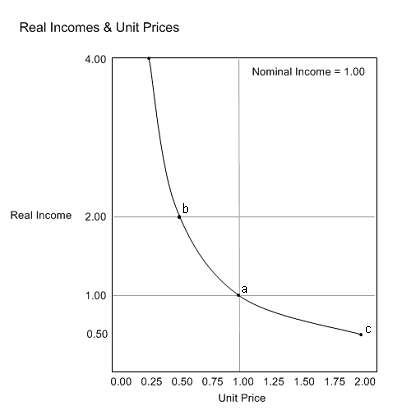
A halving of unit average nominal prices to 0.5 increases the individual real income level to 2, as depicted by point b in the graph.
Lastly, as individual average unit nominal prices rise, in the short term, real incomes fall. For example, a doubling of the individual average unit nominal prices ends up with the individual real income level falling to 0.5 as shown by point c in the graph above.
Note that the item iRI can be equated to the quantity of goods, services and money purchased by an individual i.e. iQgsm, thus:
iQgsm ~ iRI = iNI/iAUNP .................. (2)
Thus real income appears to be equivalent to the purchasing power of income expressed as the quantities of desired goods, services and money which can be purchased for a given nominal income.
1 The rationalization of real incomes measurement from a constitutional standpoint requires that analysis does not default to averages and class of consumer or economic unit. Individual prices in fact vary enormously within single markets because of the differential impacts of the degree to which equity, savings or finance are used to fund transactions. The significant inflationary impacts of finance upon transaction costs are quite often completely ignored in "market analysis" leading to incorrect market projections. By the same token the range of real income conditions is obscured and facts such as differential currency values within a single market fail to be appreciated. The value of the currency might be an absolute at any one point in time BUT its value will vary according to who is transacting and under what individual conditions. This is why KM policies generate losers, winners and unaffected groups as an outcome of any policy, even when they are differentially graded to smooth out impacts and "level the playing field". This is a complex topic which will be covered in subsequent briefs.
2 This is a vain attempt to monetarise human values and preferences using inappropriate yard sticks from the standpoint of the value placed upon non-market transactions by individuals.
3 KM is Keynesian and Monetarist.
Updates: added definition of terms for equation 1; 20th October 2014.
