The identification of an appropriate measure of economic performance capable of reflecting the specific circumstances of each person and economic unit is not as difficult as it might seem. On the other hand the use of inappropriate indices to measure economic performance can lead to poor policy decisions creating difficulties and injustice.
Each individual is just that. We are each a phenotype, that is we represent the interaction of our genotype with our cumulative environmental experience. The fact that we are all unique is born out by the fact that cumulative environmental experience is a sequence of locational-states, that is where we were and what was going on around as at each stage of our life. In reality others cannot really know what has affected us and in what ways since our interaction with our environment is a personal experience with many influences remaining subliminal and below the level of conciousness. On the other hand personal realities are that we each know which experiences we found to be pleasant and we distinguish these from those experiences we would like to avoid in the future. This is a learning process whereby we instinctively navigate our progress towards positive experiences whilst avoiding others.
What, after all, is real?
One of the weakest aspects of economic analysis is often the point assumed to be its strongest. Thus survey statistics will inform us how the nominal incomes of a population are distributed and maybe describe the typical consumption patterns associated with different income levels. The simple extension of this is to assume that individual preferences extending into social spheres can be predicted from such general economic statistics; this borders on banality. 
Charles Dickens, 1812-1870 |
In order to assume this we also assume that each person, at least in economic terms, is not unique but that each follows predictable consumption patterns based upon statistical distributions. But beyond the generalised locational-states associated with poverty, individual preferences in the use of time and money can diverge significantly. Time spent earning income might be compensated in individual terms, not by consumption of goods or services but rather opting to follow a preference to do something of specific personal interest. This might only involve the dedication of time to some preferred activity. In extending the time devoted to carrying out such a preference, a person maximises his or her level of indulgence, satisfaction, contentment and perhaps happiness derived from a personal sense of achievement of something of importance to them. Because of our innate uniqueness we each have different assessments of what is of real significance in our life and many such things can remain an enigma to others and, even to economists and politicians 1. As Charles Dickens observed in his work "A Tale of two Cities":
| "A wonderful fact to reflect upon, that every human creature is constituted to be that profound secret and mystery to every other." |
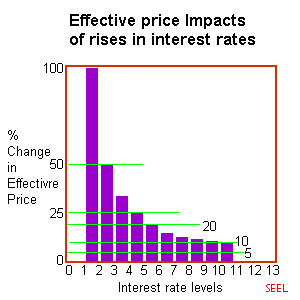 The relative impacts of interest rate changes
For each rise of 1% rise in interest rate there is a corresponding estimate of the percentage rise in the price of money (rental).
Thus a rise in interest rate from 2% to 3% represents a rise in interest rate of 100(3-2)/2 = 50%. A rise in interest rate from 5% to 6% represents a rise in the interest rate of 100(6-5)/6 = 16.66%.
The graphs shows that the lower the interest rate regime the higher the relative impact on standing loans and financial agreements, such as mortages, of rises in rates. |
|
|
So what is real is less evident than economists might imagine and yet it is the purpose of our human activity, our economy, to enable each and every one of us to remain happy and free to pursue our individual interests as far as such a pursuit does not impinge upon the freedom of others to do the same. In economic terms we can however state that for each person to be in a position to exercise freedom of choice and of expression they need to possess the means to facilitate that quest. In basic terms, where a person needs a product or service to achieve their ends, money comes in useful. On the other hand all economists know that the fundamental issue facing any individual is what is happening to their real income. The discussion above has suggested that what is real to each person is an extremely personal issue and the number of preferred pursuits involving "non marketable" resources can be quite significant. The individual trajectories of locational-state which shape an individual's preferences as to what signifies the prefereable measure of real income are difficult to measure and quantify. On the other hand, economists refer to real income as purchasing power. Purchasing power is a measure of the amount of goods and services a nominal income, measured in terms of currency units, can purchase. Such quantities will depend upon the unit prices of goods and services.
Indices, statistics and other nonsenseA method used by economists to try and estimate the movement in real incomes is to make use of a statistic made up of a basket of goods and services commonly used by the population. The Consumer Price Index (CPI)
2 is, for example, a weighted index of the product of a combination of goods and services and their respective nominal prices. If prices go up and income levels remain stable we face a circustance of inflation and a fall in real income associated with the decline in purchasing capacity. It is therefore regrettable that such an index does not include important items which determine people's real incomes such as credit card debt charges and how much people pay for mortgages. On the other hand economic policy makers use of interest rates as a policy target in achieving a control of inflation. As a result, basing general economic policy upon an attempt to keep the Consumer Price Index "within bounds" by raising interest rates will provide a false picture of real incomes simply because the Consumer Price Index has been politically sanitised to keep out important policy-dependent items. Everyone knows that a rise in interest rates will raise the direct costs to consumers of credit card debt, loans and mortgages.
Orders of dimensionThere is a fairly obvious reason why such variables as interest rate dependent outgoings are banished from the CPI. This is because the orders of magnitude of the negative impacts on real incomes of interest rate rises are large when interest rates are low. This is illustrated in the graph in the box above right. When interest rates are low there is a tendency for people to lever their current income by diverting more expenditure into debt servicing (paying off "cheap" loans). However, a rise in interest rates by say 1% arising from policy has a larger impact on the debt servicing at lower interest ranges than at higher. Thus the effective rise in interest rate associated with a rise of 1% from 3% to 4% is 33.33%. On the other hand a rise in interest rate from 12% to 13% (another 1% rise) only raises the interest rate by 8.3%. This is why raising interest rates from low levels tends to have a more significant impact on consumers because low interest rates are often associated with over-extended debt servicing in relation to ability to pay from income. It is therefore apparent that not including interest rate related consumer outlays in consumption indices is not a very realistic basis for creating consumer and retail prices indices against which to judge the success of policy
3.
Real incomes?The most useful index of real incomes is
REAL incomes. Real incomes cannot be estimated from a politically-and-policy-implication-sanitised price index. Real incomes need to be estimated on the basis of all significant outlays including all debt servicing associated with retail purchases, loans and mortages. On the other hand such an index cannot reflect the specificity of what makes up real income to any individual or economc unit. As explored in this article, it is, after all, not just purchasing power which counts but rather what people and individuals wish and do achieve within the bounds of a specific income.

Spending time enhancing an aspect of real income ..... |
As previously explored such achievement can have many elements which are not measurable in terms of marketable goods and services but have more to do with the extent of the time available within which people and corporations can exercise activities of importance to them. Without at this point exploring the issues of "opportunity costs of time" it is sufficient to accept that a more representative and comprehensive estimate of real incomes is required. It has to be acknowledged that weighting the distribution of goods and services to form some virtual basket is simply creating a statistic of the average under circumstances where, as we have explored, the average is only a partical representation void of the diversity of motivations, interests and preferences of the population. The challenge of measuring real incomes, and then designing policies to support them on a universal basis is constitutional in nature. Well-conceived policies should reflect the judgement of the community conscience as to which decisions can secure a more general growth in measurable real incomes whilst diminishing the existing trade offs that create specific pockets of recesssion through the marginalization of people's preferences which for the main part are non-marketable and therefore difficult to measure. The objective of the Real Incomes approach is therefore to sustain or increase real income levels without affecting non-marketable components. The market tells us what the measurable real income is but the constitution of the country needs to also permit public opinion to express its satisfaction or otherwise on the degree to which the same policies impact aspects of peeople's preferences which cannot be captured in price indices. At the moment policians and most economists are content to use their indices but from the standpoint of the electorate this does not give rise to policies which promote fully the aspects of real incomes which interest them. The rigorous insistence by politicians that everythng be measured in economic terms alienates and frustrates many since policies become blind to issues which are sometimes of more importance to people.
Notes:
1 This is why politicians have a tendency to try and mould preferences. In the past this was through extreme measures but now through identity and consumer politics using the media to drum up a higher profile of public awareness of "leading issues". Such issues are normally thought up by a handfull of policy makers within our tiny political parties. On the other hand, left to their own devices, the general public would not consider many such partizan-inspired presumptive "leading issues" to be of personal importance. The real significance of the concept of electorate preferences continues to allude politicians.
2 For a more detailed explanation of how the CPI is calculated see:"CPI and RPI: the 2007 basket of goods and services", Damon Wingfield, Office for National Statistics published in Economic & Labour Market Review, Vol 1, No 4, April 2007.
3 This general circumstance will not be lost on most readers who have experienced the latest financial crisis created by excessive credit and risk-taking based on low interest rates. The situation was exacerbated then the US Federal Reserve, under its new Chairman, increased interest rates in November 2007 at the highest rate of increase (see above analysis for explanation) since the Great Depression, causing all transactions operating at the limit of debt holder's cash flow capacity, such as much of the sub-prime market, into crisis. Foreign holders' circumstances were exacerbated by the falling exchange rate of the dollar and therefore by the decline in real value of returns on derivatives, expressed in terms of their national currencies.

